
The Omnichannel Order Management system offers a range of features for managing customer orders, inventory, data, and reporting across various sales channels. It helps businesses manage the order fulfillment process so that they can perform well in a competitive industry.
Consumer behavior is changing the on-demand economy of traditional and modern retail paradigms. Modern retailers are rapidly adopting automated systems to improve order and omnichannel inventory management to meet the demanding customer needs and discover untapped revenue.
What is Omnichannel Order Management?
Omnichannel order management is a complete process of managing customer orders, inventory, data and reporting across multiple sales channels, including physical locations, websites, social media, and online marketplaces.
Omnichannel order management allows you to access customer, order, and inventory information across all channels. It integrates the relevant information needed for e-commerce and point-of-sale systems to operate efficiently.
4 Things A Customer-centric Omnichannel Order Management System Provides
- Fast delivery with consistent accuracy
- Convenient service for retail businesses
- Real-time data accuracy and reliability
- Hassle-free returns
Why Omnichannel Order Management is Needed?
- Modern-era Customers expect fast delivery with consistent accuracy from retailers.
- They demand personalized, localized and engaging experiences.
- Order fulfillment becomes excessively time-consuming without an omnichannel order management system.
- In a simple order management system, different employees have different processes for inventory and fulfillment. Thus inventory count errors, back orders, and lost orders start piling up.
- Real-time data accuracy and reliability are missing in simple order management software.
- Order backlogs become risky when shipping times are slow or unreliable.
- The risk of human error persists and customer satisfaction begins to suffer
Key Features of Omnichannel Order Management
The main features are omnichannel order routing, store fulfillment, and enterprise inventory. It also includes a customer service platform, allowing the retailer to see a complete view of the business with real-time insights in a single, unified dashboard. An omnichannel OMS allows customers to shop anywhere and return anywhere. A complete omnichannel OMS empowers both your employees and your customers.
Today’s order management software must do more than simply manage orders to online sales. Retailers need a central repository for inventory and orders and require an OMS for that. Retailers need to use the OMS to move the inventory and deliver it to the consumers based on their preferred method. For the e-commerce platform and POS to operate efficiently, the OMS has to be properly integrated. The OMS must also provide retailers with the tools needed to provide efficient customer service and a unified customer experience across all channels.
Order Management System (OMS) keeps a check on sales, orders, inventory, and fulfillment. It evaluates the available channels and selects the best possible option to fulfill an order. It has a centralized decision-making system. With customer expectations high and a quickly transforming sales landscape, order management is now evolving into a multi-dimensional system that touches every facet of your business operations.
The following features of an omnichannel OMS are important for a modern retailer:
1. Multi-channel Processing of Orders
One of the main features of an OMS is to process orders from multiple channels. This includes orders that are placed on one channel and fulfilled from another channel. Merchants should be able to get orders from multiple channels like website, mobile, marketplace, social channels, call or chat representatives and should be able to fulfill them through a warehouse or store.
2. Product Availability Across All Channels
An omnichannel order management system monitors available stock, in transit, and purchase orders and provides visibility across all channels. It informs customers about the availability of products and acts as the central hub.
3. Routing of Orders
An omnichannel order Management system helps in routing the order efficiently while considering profitability, proximity and inventory levels. It chooses the closest routes that require the shortest time and the least courier costs, according to customer expectations.
4. Return Policy
No matter the stage at which the return originated, it is vital to have a smooth process of return in place for an optimal customer experience. Though this process might seem complicated in an omnichannel setting, OMS effectively tracks the items at all stages in the return process and hence automates its return to stock. It also collects data regarding product quality and customer complaints for better business decisions in the future.
5. Scheduling Delivery and Service
Apart from an OMS successfully capturing the orders, certain products may require a service schedule for additional tasks such as installation. This happens after the order is placed and it enables a timetable for delivery and service to optimize customer experience and cater to the customer needs better.
Global Omnichannel Order Management System Market
According to Maximize Market Research, the Compound Annual Growth Rate (CAGR) of the Omnichannel Order Management Systems Market is projected to be 10.4% during the forecast period, with the market size expected to reach nearly US$ 5.23 billion by 2029.

How Omnichannel Order Management System Works
Main processes:
- Create orders
- Track orders
- Administer orders
- Report and analyze against orders
Benefits of Omnichannel Order Management
1. Sell and return anywhere
In larger businesses where a lot of inventory is involved, sales and returns can be challenging. Omnichannel order management facilitates you to sell and ship finished goods from anywhere and also enables you to see customers’ order history for a smooth shopping process.
If a customer needs to return or make an exchange, it’s important that you offer a unified returns process by offering your customers the option to return and initiate exchanges in-store or through self-service tools.
In the short run, you may lose money on a return, but you can easily get a repeat customer by handling the return positively.
2. Improves customer satisfaction
Customers want to be assured that they will have access to your product, no matter where they are.
Implementing a unified omnichannel order management greatly improves customer satisfaction with the ability to sell, deliver, and return products from anywhere.
It further ensures that all sales channels are using the same inventory data to prevent stockouts and backorders.
Omnichannel order management makes the buying and return process as smooth as possible.
3. Simplifies logistics workflows
The internal logistics operations also improve with an OMS. When all the orders are connected in one place, it’s easier to manage your order, inventory, and returns.
Omnichannel solutions enable accurate inventory, order, and returns data across channels to ensure orders are fulfilled and shipped quickly and returns are processed smoothly.
4. Maintains a seamless brand experience
An OMS gives the ability to maintain a consistent brand experience across channels.
So no matter what the customers’ preferred methods of shopping are, you can provide a unified brand experience for orders purchased in-store, on the website, and through third-party channels.
This gives you a seamless presence across different channels of distribution and touchpoints, increasing customer loyalty in the long run.
5. Scale operations with ease
It’s easier to add new sales channels to your operations with an OMS.
For example, adding an additional sales channel means adding it to your existing strategy, not trying to accommodate one from scratch.
You instantly start selling on the new platform without any disruptions to your current operations, including inventory management, fulfillment, and shipping.
Omnichannel Order Management Best Practices
The omnichannel order management software you choose must have the following features:
1. Optimized Inventory
It is able to automatically update inventory across all channels. So, if a customer buys something through any channel, the stock levels should be updated automatically across all the sales channels.
Also, it should include algorithms that route your orders to appropriate warehouses and fulfillment centers and identify the right shipping options for each sale. The inventory data is hence useful during the picking, packing, and shipping process.
2. Centralized Workflows
There should be centralized workflows for processing all customer orders as well as any returns. Further, you will need to be able to access past and current customer data, including all purchases across different channels.
3. Multi-Channel Listing Management
Updating SKUs and catalog management is an important feature of an order management system. The OMS chosen should make it easy to create and update product listings, including price information, across all of your channels from one place, instead of having to do manual updates.
4. Courier Integrations
An efficient order management system integrates with all of the major couriers.
5. Business Intelligence
The business intelligence feature of omnichannel order management software provides clear and accurate customer reports and insights.
Level up your Customer & Staff journey
First, you need to understand the customer and your staff's pain points in your current environment.
In most cases, the following pain points exist
| Your Customer Demands | Your Pain Points |
|---|---|
| Expect fast delivery with consistent accuracy | Order fulfillment becomes excessively time-consuming |
| Personalized, localized and engaging experiences | Real-time data accuracy and reliability |
| Customer satisfaction begins to suffer | Delays, Risk of human error |
| Orders Tracking | Inventory count errors, back orders, and lost orders start piling up |
| Hassle-free returns | Different employees have different processes for their inventory and fulfillment. |
Choosing The Right Omnichannel Order Management System
PostEx’s product provides order management, inventory management, logistic and supply chain management and business intelligence modules. These modules are:
Order Management
End-to-end automated order management workflow from online order placement to splitting, assigning to a location to booking it with a courier and tracking its final status. It helps you identify duplicate orders and orders placed by blacklisted customers through machine learning so that you do not deliver to them.
Real-Time Inventory
Real-time inventory and order sync between your web store and multiple physical locations (both warehouses and physical stores), with integrations for POS and ERP systems.
Logistics and Supply Chain Management
Track all orders, packages and their shipping status in real-time, booked across multiple couriers, providing top-notch customer service.
Business Intelligence Dashboard
Explore and analyze real-time data reliably. Track, analyze and process sell-through rate, courier performance, critical orders, min-max of the store, store rankings, and stock opening/closing.
Tired of Excessive Time-Consuming Order Fulfillment Process?
Learn How PostEx's Order Management System Solve This Problem
Book DemoHow PostEx Omnichannel Order Management Works
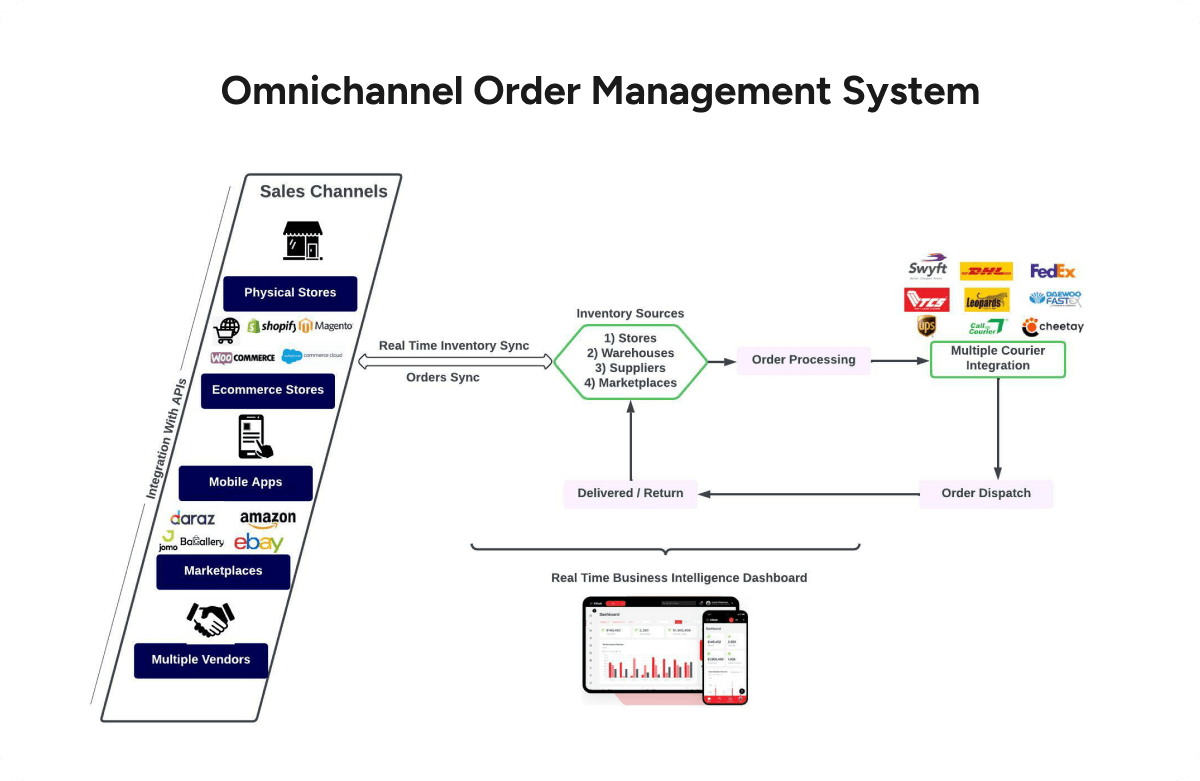
An order management flow chart is a graphic and diagrammatic representation of the processes involved in order management.
Certain actions take place behind the scenes before their order is fulfilled when a customer places an order. These actions make up the Omnichannel order management workflow.
Workflow in omnichannel order management is the activities that make it possible to fulfill customer orders. This includes everything from accepting customer orders, creating invoices, managing inventory, and packaging items for shipment.
Omnichannel Order Management Process Flow Chart
Conclusion
An omnichannel order management system is necessary for a modern retailer to satisfy customers who demand a unified shopping experience on all platforms. Get a free demo of a modern Omnichannel Order Management System.