
The e-commerce in Saudi Arabia is thriving, driven by Vision 2030’s push for digital transformation and a growing consumer base, with over 33% of the global population shopping online.
For e-commerce businesses, managing multi-channel orders and inventory and complying with local regulations like ZATCA are complex challenges. Enterprise Resource Planning (ERP) systems are the backbone of efficient operations, integrating sales, inventory, shipping, and financials into a unified platform.
The right ERP can streamline processes, reduce costs, and ensure scalability for both small and large businesses.
This article covers the top four ERP systems tailored for e-commerce businesses in Saudi Arabia:
- PostEx OMS
- Oracle NetSuite ERP
- Odoo ERP
- Omniful
We’ll compare their features, benefits, and suitability for the Saudi market, helping you make an informed decision.
Ready to transform your e-commerce operations? Let’s explore the best ERP solutions and find the perfect fit for your business.
Why E-commerce Businesses in Saudi Arabia Need ERP Systems
E-commerce businesses in Saudi Arabia face unique challenges that demand robust solutions.
From managing orders across platforms like Salla, Zid, Shopify, Amazon, and local marketplaces like Noon to ensuring real-time inventory accuracy, manual processes often lead to errors, delays, and lost sales.
In addition to that, there is a need for compliance with ZATCA’s e-invoicing mandate and the pressure to scale operations in line with Vision 2030’s economic diversification goals, and the case for an ERP system becomes clear.
Key Challenges for E-commerce Businesses
- Multi-Channel Order Management: Syncing orders from various platforms in real time.
- Inventory Accuracy: Preventing stockouts or overstocking, especially during peak seasons like Ramadan or White Friday.
- Shipping and Logistics: Coordinating local and international deliveries efficiently.
- Regulatory Compliance: Adhering to ZATCA e-invoicing and Saudi tax regulations.
- Customer Expectations: Delivering fast, transparent order updates to maintain satisfaction.
Benefits of ERP Systems
An ERP system addresses these challenges by:
- Automating Processes: Streamlining order processing, invoicing, and inventory updates.
- Providing Real-Time Insights: Offering data-driven decisions for inventory and sales forecasting.
- Ensuring Compliance: Supporting ZATCA-compliant invoicing and tax reporting.
- Enabling Scalability: Handling increased order volumes as businesses expand locally or globally.
For example, a Saudi e-commerce retailer using an ERP can integrate Zid and Noon orders, track inventory across multiple warehouses, and generate ZATCA-compliant invoices in real time, saving hours of manual work.
According to industry reports, 95% of companies see process improvements after adopting ERP systems, making them essential for staying competitive in Saudi Arabia’s booming e-commerce market.
Key Features to Look for in an e-commerce ERP System
Selecting the right ERP system requires understanding the features that align with e-commerce needs and Saudi-specific requirements. Here are the critical features to prioritize:
- Order Management: Seamless integration with e-commerce platforms like Zid, Salla, Shopify, WooCommerce, Amazon, and Noon for unified order processing.
- Inventory Management: Real-time tracking across multiple warehouses and store locations to prevent stockouts and overstocking.
- Shipping and Logistics: Integration with local couriers and global shipping providers for automated tracking and delivery updates.
- ZATCA Compliance: Built-in support for Saudi Arabia’s e-invoicing regulations and tax reporting.
- Scalability: Ability to handle growing order volumes and support international expansion.
- Analytics and Reporting: Dashboards for sales, inventory, and financial performance to drive data-based decisions.
- Customization: Flexible modules to adapt to unique business workflows, such as dropshipping or omnichannel retail.
- Customer Communication: Automated order confirmations, shipping updates, and return processing to enhance customer satisfaction.
These features ensure your ERP system not only addresses current pain points but also future-proofs your business. For instance, a system like PostEx OMS can automate all e-commerce and retail operations, improving efficiency by up to 45%.
Top ERP Systems for e-commerce Businesses in Saudi Arabia
Below, we explore four leading ERP systems, detailing their e-commerce-specific features, Saudi market suitability, pros, cons, and pricing insights based on available data.
PostEx OMS – E-commerce ERP Integration Partner
.png)
PostEx OMS acts as a specialized ERP integration partner for e-commerce businesses in Saudi Arabia, enabling seamless connectivity across order management, inventory, logistics, and other core operations. Rather than replacing your existing ERP, PostEx enhances it, bridging the gap between your online sales channels and backend systems.
Key E-commerce Integration Capabilities
- Multi-channel order syncing with Zid, Salla, Shopify, WooCommerce, and Noon
- Real-time inventory visibility across multiple warehouse locations
- Integrated shipping with local couriers and international logistics providers
- Customer communication modules for order updates and delivery tracking
- Actionable analytics for inventory forecasting and sales optimization
Full ERP Integration Coverage
- Finance ERP integrations for streamlined invoicing, reconciliation, and reporting
- POS system integrations to unify in-store and online order data
- Custom ERP solutions supported through flexible APIs and connectors
Tailored for the Saudi Market
- ZATCA-compliant e-invoicing support for smooth tax and regulatory reporting
- Integration with local payment gateways and compliance with KSA regulations
- Scalable infrastructure aligned with Saudi Vision 2030’s digital commerce goals
Pros
- Comprehensive ERP integration across finance, POS, logistics, and inventory
- Built for high-order-volume retailers and marketplace sellers
- Competitive pricing structure for SMEs and enterprise-level businesses
Cons
- Not a standalone ERP (acts as a bridge between systems)
Why Choose PostEx OMS?
PostEx OMS is purpose-built for Saudi e-commerce retailers that want to scale operations without replacing their existing ERP stack. Whether you're using NetSuite, SAP, or custom finance and POS systems, PostEx enables end-to-end order orchestration and logistics visibility, while ensuring compliance and speed in a fast-moving market.
Oracle NetSuite ERP
.png)
Oracle NetSuite ERP is a cloud-based, comprehensive ERP suite trusted by over 38,000 businesses globally. It excels in e-commerce with robust integrations for B2B and B2C channels, offering scalability for enterprises.
Key e-commerce Features
- Suite-commerce Advanced for seamless B2B and B2C e-commerce integration.
- Multi-location inventory tracking and warehouse management system (WMS).
- Automated order processing and financial management.
- Real-time analytics for sales, inventory, and customer behavior.
- Mobile proof of delivery (via third-party apps).
Saudi-Specific Benefits:
- ZATCA-compliant invoicing and tax reporting capabilities.
- Global scalability for businesses expanding beyond Saudi Arabia.
- Local support through partners like ERP Success Partners.
Pros:
- Comprehensive suite covering financials, CRM, and e-commerce.
- Highly scalable for large enterprises with complex needs.
- Cloud-native with automatic updates, eliminating downtime.
Cons:
- Longer implementation period, often requiring expert partners.
- Higher costs make it less accessible for SMEs.
- Some users report poor customer support.
Why Choose NetSuite?
NetSuite is perfect for large e-commerce enterprises in Saudi Arabia needing a robust, all-in-one solution with global reach, though its cost and complexity may deter smaller businesses.
Odoo ERP
.png)
Odoo is an open-source ERP platform with over 82 business apps, offering flexibility and cost-effectiveness for e-commerce businesses. Its modular structure allows customization to fit specific needs.
Key e-commerce Features
- Fully integrated apps for e-commerce, inventory, sales, and accounting.
- Multi-channel support for Shopify, Amazon, and local platforms like Noon.
- Dropshipping and warehouse management capabilities.
- Intuitive UI with Gantt, Kanban, and Calendar views for order tracking.
- Real-time reporting for sales and inventory performance.
Saudi-Specific Benefits
- ZATCA-compliant invoicing through localized modules.
- Local implementation partners like Bista Solutions for tailored support.
Pros
- Cost-effective with a free tier for single-app use.
- Highly customizable for unique e-commerce workflows.
- User-friendly interface suitable for SMEs and non-technical users.
Cons
- Limited advanced features for complex manufacturing compared to NetSuite.
- Implementation timelines may extend for custom setups.
- Community-driven support may lack the depth of enterprise-grade solutions.
Why Choose Odoo?
Odoo is a budget-friendly, flexible choice for Saudi e-commerce SMEs needing customizable solutions without the high costs of enterprise-grade ERPs.
Omniful
.png)
Omniful is a cloud-based ERP and order management system (OMS) designed for e-commerce and retail, emphasizing supply chain and logistics. It’s a rising star in Saudi Arabia for its focus on omnichannel operations.
Key e-commerce Features
- Automated order processing and multi-channel integration (Shopify, Noon, Amazon).
- Multi-location inventory tracking for real-time visibility.
- Customer communication tools
- Advanced reporting for demand forecasting and KPIs.
- Seamless ERP integration for financial and supply chain management.
Saudi-Specific Benefits
- ZATCA-compliant e-invoicing and local regulatory support.
- Tailored for Saudi’s e-commerce boom, aligning with Vision 2030.
- Scalable for SMEs and enterprises expanding in the region.
Pros
- Strong focus on e-commerce logistics and customer satisfaction.
- Cost-effective compared to NetSuite, with flexible pricing.
- Fast implementation for rapid deployment.
Cons
- Less comprehensive than NetSuite for non-e-commerce functions.
- Pricing requires vendor consultation, which may delay budgeting.
- Limited global reach compared to NetSuite or Odoo.
Why Choose Omniful?
Omniful is ideal for Saudi e-commerce businesses focused on streamlining order management and logistics with a modern, scalable solution.
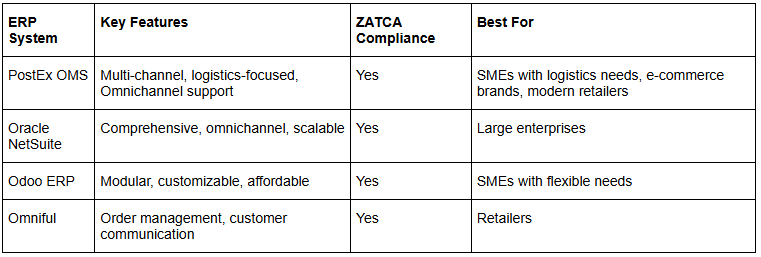
ERPs System Comparison
How to Choose the Right ERP for Your e-commerce Business
Selecting the best ERP system depends on your business size, goals, and operational needs. Here’s a step-by-step guide to make an informed choice:
- Assess Business Size and Needs
- SMEs: Prioritize cost-effective solutions like PostEx OMS for flexibility and affordability.
- Enterprises: Opt for scalable, comprehensive systems like PostEx OMS and Oracle NetSuite.
- Evaluate e-commerce Platform Integrations
- Ensure seamless syncing with platforms like Salla, Zid, Shopify, Noon, or Amazon. All four ERPs support major platforms, but PostEx excels in local integrations.
- Check ZATCA Compliance
- All listed ERPs offer ZATCA-compliant e-invoicing, critical for Saudi businesses. Verify local support through implementation partners.
- Consider Scalability
- Choose a system that grows with your business. PostEx OMS and Omniful are highly scalable.
Example: A Saudi SME selling on Noon and Shopify might choose PostEx OMS for its affordability and customization.
Case Study: ERP Success in Saudi e-commerce
A mid-sized e-commerce retailer in Riyadh struggled with manual order processing across Shopify and Noon, leading to stockouts and delayed shipments during White Friday sales. After implementing PostEx OMS, the retailer integrated its sales channels, automated inventory updates, and ensured ZATCA-compliant invoicing.
The result
A 30% reduction in order processing time, 25% lower inventory costs, and improved customer satisfaction due to real-time order tracking.
This success story highlights how ERP systems can transform e-commerce operations in Saudi Arabia, aligning with local needs and driving measurable results.
Choosing the right e-commerce ERP
The e-commerce boom in Saudi Arabia, fueled by Vision 2030, demands robust ERP systems to manage complex operations and ensure compliance. PostEx OMS excels in logistics and order management. Each system addresses key e-commerce needs, multi-channel integration, inventory tracking, and ZATCA compliance, while catering to different business sizes and goals.
To choose the right ERP, assess your needs, test demos, and consult with implementation partners. Ready to streamline your e-commerce operations?
Schedule a free consultation with PostEx to find the perfect ERP for your Saudi business.